
Basicity
Nitrogen in amines is electron-dense because of the lone pair electrons, as shown by the red color in the electrostatic potential map to the left. Acids are electron-poor and react easily with basic amino acids.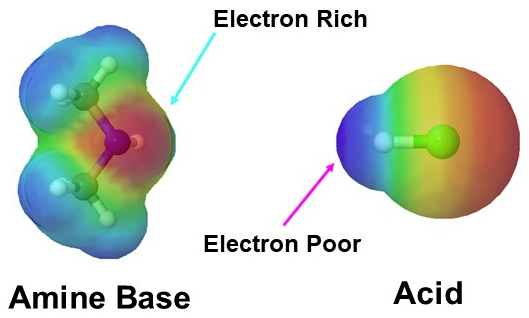

The following equation shows that when a proton is transferred to an amine, ammonia and water will react, yielding an ammonium salt and a hydroxide ion:

Known also as the base dissociation constant (Kb), the equilibrium constant for this reaction is:

Using the same method as described in Section 2-8 to calculate a carboxylic acid's acid strength, we can determine an amine's base strength by defining analogous basicity constant. If Kb is larger and pKb is smaller, then proton-transfer equilibrium is more favorable and the base is stronger.

Known also as the base dissociation constant (Kb), the equilibrium constant for this reaction is:
Using the same method as described in Section 2-8 to calculate a carboxylic acid's acid strength, we can determine an amine's base strength by defining analogous basicity constant. If Kb is larger and pKb is smaller, then proton-transfer equilibrium is more favorable and the base is stronger.
Effect of substituent on basicity
- An amine is basic because each atom possesses two electrons that can be shared with another atom. The nitrogen atom is surrounded by an electron density created by these unshared electrons.
- An electron-rich molecule is more basic than one with few.
- Using a positive inductive effect, electron-donating or supplying groups like alkyl groups (-H3, etc.) will result in increased basicity, while electron removing groups like -NO2, etc. will decrease the basicity of the molecule.
- Due to the electron density created around the nitrogen atom of the amine, its electron-releasing capabilities increase due to the electron-donating properties possessed by the attached alkyl group.
- Alkylamines, because they release electrons more easily and more readily, are therefore more basic than ammonia.
- Basicity – order: NH3<1<2<3
Steric hindrance
- The number of alkyl groups in an alkyl group is greater than the number of hydrogen atoms.
- Alkyl groups prevent hydrogen atoms from attacking them, thus decreasing the molecule's basicity.
- Alkyl groups are a measure of basicity, and the more there are, the slower it will be.
- As a result, amines are ordered ascendingly: tertiary amine < secondary amine < primary amine.
Salvation effect
- It is a relatively strong base, and its aqueous solutions are fairly straightforward.
- Aqueous and gaseous solutions have different basicity orders due to hydrogen bonding (solvation effects).
- Hydroxide and ammonium ions can be produced by absorption of a proton by amines.
Get subject wise printable pdf notesView Here
Dr. Ankur Choudhary is a prominent Pharmaceutical Quality Assurance expert, consultant and the founder of Pharmaguideline. With over 22 years of hands-on experience in cGMP-compliant manufacturing environments, he specializes in establishing validation protocols, sterile area controls and data integrity systems. Ankur routinely interprets international regulatory frameworks (including FDA, EMA and ICH guidelines) to help global pharmaceutical professionals ensure strict regulatory compliance and operational excellence. Connect with Ankur on LinkedIn. Need Help: Ask Question

No comments:
Post a Comment
Please don't spam. Comments having links would not be published.